
So, we asked “Who am I becoming?”. Now the question is:
What does this actually look like when I wake up tomorrow?
This is where things often get complicated. Up to this point, everything’s mostly internal.
Attention. Pattern recognition. Ordering. Healing. Identity.
None of it easy, but all of it largely invisible. You can do it quiet. Private. Even imperfect, without immediate consequence.
Action is different.
Action exposes what’s real. It introduces friction. It reveals gaps between intention and embodiment. And because of that, it’s tempting to delay it until everything inside feels resolved.
Insight to Incarnation
I’ve done that more times than I can count. Waiting for clarity to become certainty. Waiting for healing to feel complete. Waiting for identity to feel unshakeable. The waiting is often just another way of staying protected from the vulnerability of living what I say I believe.
The problem most of us face is not a lack of sincerity. It’s the absence of structure. This is the gap where most self-development efforts die. Not from lack of insight, but from lack of incarnation. We can accumulate understanding like we’re building a library, but we never actually do what is written in any of it’s books.
I used to think discipline only meant pushing myself to do the right thing. What I’m seeing now is that discipline is often about arranging life so the right thing becomes more likely. And the wrong thing becomes harder to justify. That shift matters, because willpower is finite. Systems endure.
We want to live differently, but we haven’t ordered our lives in a way that makes different living possible. We rely on intention where what’s actually required is form. We hope conviction will carry us where only practice can.
Transformation happens when your inner clarity meets external structure.
When action is embodied well, it stops feeling like constant self-correction and starts feeling like alignment. You’re still choosing, but you’re doing so within boundaries that support who you’re becoming rather than sabotage it.
This is most clear when I look at my days honestly. Not my intentions for them, but their actual shape. Where attention goes. Where energy leaks. Where friction appears again and again. Action forces honesty. Not through accusation, but through exposure.
That’s why many of us prefer reflection. Reflection can stay clean. Action gets messy.
Without embodiment, values remain opinions. With embodiment, they become commitments.
Paul names this tension directly in Romans 7:15: “I do not understand what I do. For what I want to do I do not do, but what I hate I do.” This is the anguished recognition that self-knowledge alone cannot bridge the distance between who we are and who we long to become.
The Christian tradition has always known this.
That’s why it has never treated formation as merely intellectual. Christianity is not a system of ideas you agree with. It is a way of life you submit yourself to. A truth that must be inhabited, not merely affirmed. It takes on flesh. It enters time, habit, space, and limitation. It submits itself to repetition. It accepts the cost of obedience.
Jesus didn’t form His disciples through lectures alone. He formed them by sending them. By giving them concrete commands. By placing them in situations where understanding had to become action.
“Go.”
“Follow me.”
“Take up your cross.”
“Remain in me.”
Formation happened in the doing.
Effective Action Must Be Structured
When life is organized around what matters, there’s less internal debate. Less constant renegotiation. Fewer moments of wondering why you feel pulled in opposite directions. Identity starts expressing itself without requiring constant effort.
I’ve also noticed that this kind of action changes how failure feels. When I fall short within a coherent system, the failure becomes informative rather than condemning. It shows me where support is missing, where expectations are unrealistic, or where healing hasn’t reached yet.
Embodied action also protects against drift. Without it, even sincere people slowly slide toward what’s easiest, loudest, or most immediately rewarding. Not because they don’t care, but because nothing is holding their attention in place.
Structure does that. Healing finds direction. Identity finds expression. Purpose finds form.
And the form matters.
Where you place your time.
How you structure your environment.
What rhythms you keep.
Who you give access to your inner world.
What you return to daily without thinking.
These are not neutral. They are shaping you continuously, whether you’re intentional or not.
So the question isn’t whether you’ll be formed by your actions. You already are.
The question is whether that formation is accidental or aligned.
Unstructured action fragments as easily as unstructured reflection. You can be disciplined in one area and negligent in another. Faithful in language and avoidant in relationships. Spiritually earnest and practically disordered.
This is why Christian ethics have always insisted on ordered life—rule, rhythm, practice, habit. Not as legalism, but as mercy. A way of making faith livable under real conditions. The Christian moral framework is diagnostic, yes. But more importantly, it’s activating. Where is decay creeping in? Where does life need to be restored? What do I need to submit to the authority and Lordship of Christ?
Without structure, action defaults to convenience.
Without rhythm, conviction dissolves under pressure.
Without boundaries, intention gives way to drift.
What’s required here is not intensity, but coherence.
A life arranged so that what you claim to believe actually has somewhere to land.
Work. Body. Environment. Relationships. Attention. Learning. Rest. Direction. These are not secular distractions from spiritual life—they are the places where spiritual life either becomes real or remains theoretical.
Jesus never treated daily life as spiritually irrelevant. He spoke constantly about money, time, food, anxiety, authority, labor, rest, and responsibility. Because these are the domains where allegiance shows itself.
Action, when structured well, stops being a test of willpower and becomes an act of alignment.
Power of Practice
This is why practices matter. They shape attention. They train desire. They tell the truth about what we actually worship.
A life without practices is not free. It is simply shaped by whatever is loudest, easiest, or most immediately rewarding.
When practices are integrated across life, something stabilizing happens. Decisions require less internal negotiation. Identity expresses itself without constant effort. You stop renegotiating your values every morning.
Failure changes too.
When life has form, failure becomes instructive rather than condemning. It reveals where support is missing, where expectations are unrealistic, or where healing hasn’t fully reached yet.
Instead of asking, Why can’t I get this right?
The question becomes, What isn’t supporting the life I’m trying to live?
That question leads somewhere.
But here’s what makes this different from productivity culture or relentless self-optimization: The goal isn’t just to have your life together. It’s not control, efficiency, or having your life perfectly managed. The point is to become someone capable of giving your life away.
All the earlier steps—understanding yourself, identifying patterns, organizing your inner world, healing what’s broken, building stable identity, acting on what matters—they’re not ends in themselves. They’re preparation. They’re clearing the debris for something sturdier:
the capacity to love well.
And over time, something else happens.
Not in some vague, sentimental way. But in the concrete, costly, daily-death-to-self way that Jesus modeled and Paul described in 1 Corinthians 13. Love that is patient. Love that is kind. Love that doesn’t envy or boast. Love that protects, trusts, hopes, perseveres.
This kind of love requires enormous internal stability. You can’t give what you don’t have. A fragmented person produces fragmented relationships. An anxious person exports anxiety. An unhealed person wounds others, often without meaning to.
But a person who has faced their patterns, healed their wounds, built a stable identity, and organized their life around what matters—that person has something solid to offer.
They can be present without constantly needing to be fixed.
They can listen without making everything about themselves.
They can hold tension without collapsing into reactivity.
They can serve without scorekeeping.
They can give without running empty.
This is what wholeness looks like in practice: not self-containment, but self-gift.
Relational, Integrated, Resilient Wholeness
There’s a passage in Ephesians 4 that captures this perfectly. Paul writes about the body of Christ growing and building itself up in love, “as each part does its work.” Not as isolated individuals pursuing self-actualization, but as a community of people who have been transformed so that they can participate in something larger than themselves.
The Greek word Paul uses is oikodomeō—literally, “to build a house.” Wholeness isn’t a private achievement. It’s a relational architecture. It’s what happens when healed people build their lives together in a way that creates space for others to heal too.
This is about becoming someone who can carry weight for others.
Can you hold someone’s story without needing to fix it?
Can you stay steady when everything around you is chaotic?
Can you lead without dominating?
Can you serve without resentment?
Can you forgive without keeping a ledger?
Can you love without needing to be loved back in equal measure?
This is the ultimate outcome. This is what all the inner work is for.
A Small Action
Lately, I’ve been paying attention to one small area at a time. Not trying to optimize everything—just noticing where my life feels misaligned and experimenting with structure rather than force.
Where am I constantly compensating instead of being supported?
Where does effort spike because clarity is missing?
Where do my values exist only as language?
Those questions don’t always lead to immediate answers. But they do lead to embodiment. To adjustments that make the next right action easier to take and harder to avoid.
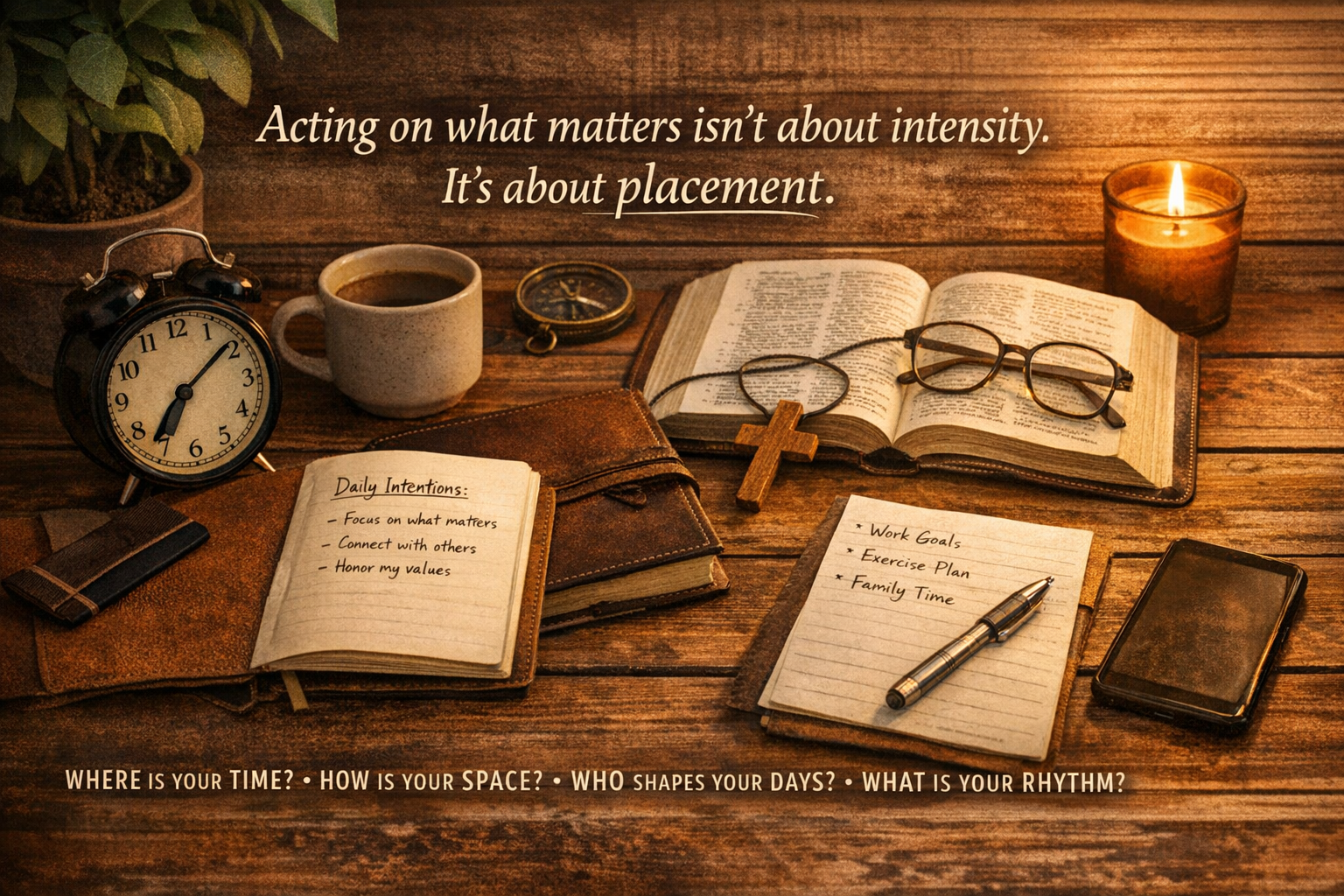
I’m realizing that acting on what matters isn’t about intensity. It’s about placement. Putting the right things in the right places so they can actually shape you.
Identity becomes visible here. Not in what you claim, but in what your life consistently makes room for.
So here’s where it gets practical. If you’ve been following this path, then you’re ready for the next question:
What is one small action you can take today that either (1) aligns with your purpose or (2) strengthens a relationship?
Not a grand gesture. Not a complete life overhaul. Placement. One small, concrete act that aligns your life with what you say matters.
Maybe it’s:
- A message sent instead of delayed.
- Silence instead of distraction.
- An apology instead of justification.
- A boundary instead of resentment.
- Attention instead of avoidance.
- Creation instead of consumption.
The specifics matter less than the practice of choosing and doing (obeying!).
Transformation doesn’t happen in one dramatic moment. It happens in a thousand small choices, repeated over time, until the new way of living becomes simply who you are.
Jesus called this “abiding.” Remaining. Staying connected to the source of life so that life flows through you naturally, not as forced effort but as overflow.
“Remain in me, as I also remain in you. No branch can bear fruit by itself; it must remain in the vine” (John 15:4).
Life flows where connection is maintained. Not where effort spikes. The wholeness we’re building isn’t something we achieve through sheer willpower. It’s something we receive and then practice into existence, day after day, choice after choice, until what was once aspirational becomes simply true.
The Long Direction
The gap between knowing and becoming can feel enormous. There will be days when you understand exactly what you should do and still can’t seem to do it. Days when the old patterns reassert themselves with surprising force. Days when you feel like all the progress you’ve made has evaporated overnight.
The work isn’t about perfection. It’s about direction.
Are you moving toward life or toward decay?
Are you choosing embodiment or remaining in abstraction?
Are you building capacity to love or just refining your self-understanding?
These questions reorient everything.
Because in the end, the point of knowing yourself isn’t to become obsessed with yourself. It’s to free yourself from yourself so you can actually show up for the people and purposes that matter.
This is what the whole journey has been building toward:
A life that is whole, honest, and awake.
Aligned with God instead of drifting.
Integrated instead of fragmented.
Capable of love instead of chronically self-absorbed.
Not because you’ve figured everything out. Not because everything is healed.
But because the truth is being lived. Not someday, but here. And now.
And you’re still doing it.
One small action at a time.
Discover more from Will Eason
Subscribe to get the latest posts sent to your email.
