
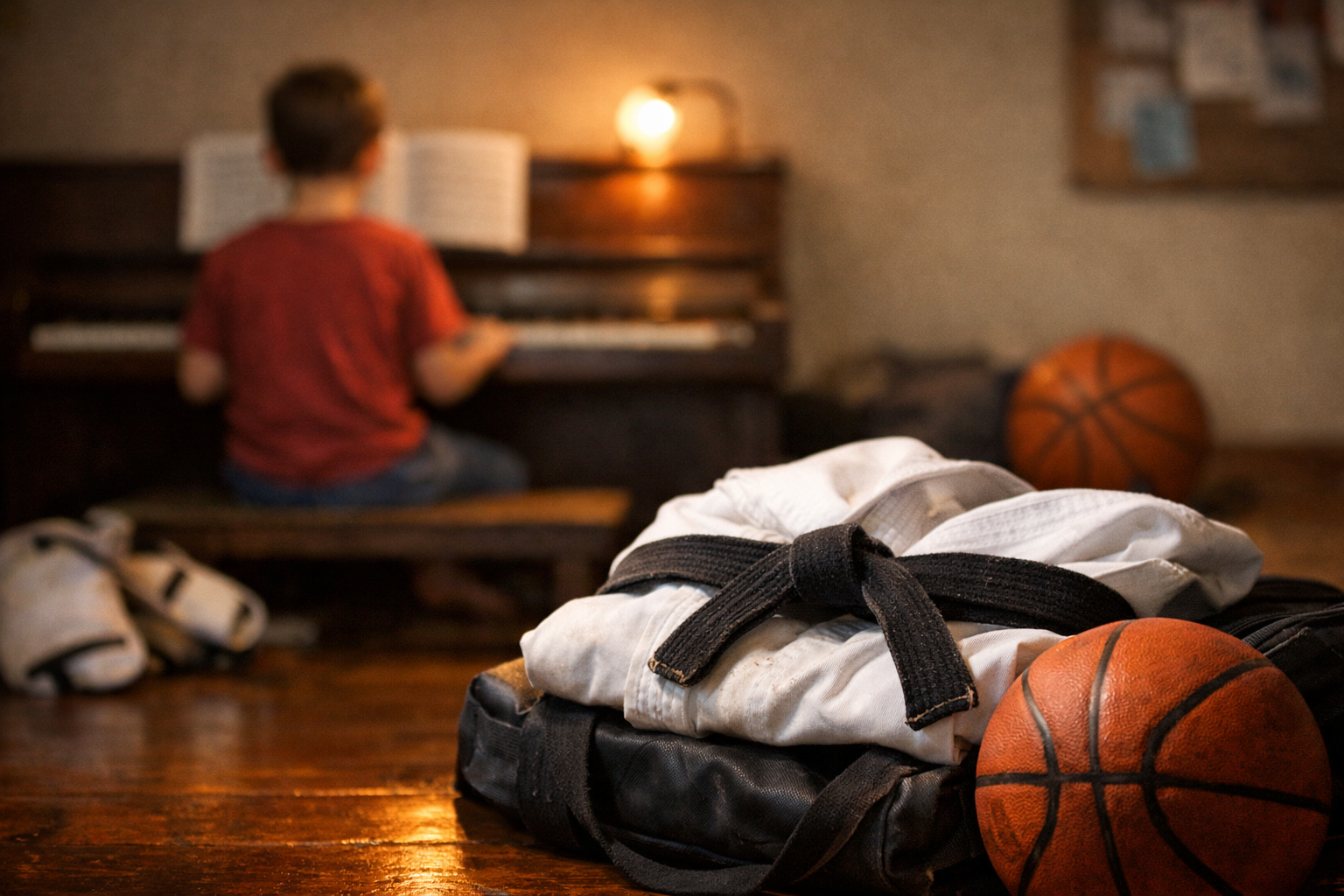
At eight and nine years old, I enjoyed playing basketball, piano, and taking karate lessons. I was taught early that effort mattered. Practice worked. I learned that things changed with consistent practice. My hands became more coordinated. My body more responsive. My confidence less fragile.
No one explained this long-term payoff. I wasn’t optimizing myself or building a résumé. I was simply participating. Submitting to structure. Letting repetition do its thing.
Progress is usually boring up close. It requires presence before it produces clarity.
Being homeschooled while moving through co-ops and afterschool programs, I learned to navigate different environments, different expectations, different kinds of people. There was no single script. You adjusted. You paid attention. You learned that other people brought different strengths to the same shared activity. Coordination mattered as much as individual effort.
All of this happened before self-conscious identity took over. Before I started asking who I was or what I was becoming. Before belief, doubt, ambition, or shame complicated the picture.
And that’s the part that stays with me.
What the Body Learns in the Calm
There’s a reason soldiers drill in peacetime. A reason musicians practice scales for years before the concert. A reason athletes run the same play hundreds of times before the game that matters.
When chaos comes—and it will—you don’t “rise to the occasion”. You fall to the level of your training.
The writer of Hebrews talks about those “who through faith and patience inherit the promises” (Hebrews 6:12). Not through adrenaline. Not through last-minute heroics. Through faith and patience. The slow accumulation of faithfulness when nothing urgent is demanding it.
Paul says it even more directly: “Train yourself to be godly” (1 Timothy 4:7). The verb “γυμνάζω” (gymnazo—where we get gymnasium) in 1 Timothy 4:7 means “to train” or “to exercise.” Physical training. Muscle memory. The kind of discipline that doesn’t wait for inspiration.
He continues: “Physical training is of some value, but godliness has value for all things, holding promise for both the present life and the life to come” (1 Timothy 4:8).
If your body learns through repetition in the calm, why would your soul be any different?
When We Forget and Start Drifting
Later in life, when things became more abstract—when faith, meaning, and responsibility moved from the body into the mind—I often forgot what I had already learned. I searched for insight when what I needed was practice. I waited for clarity when what was required was presence. I tried to think my way forward in areas that only move through repetition and commitment.
Drift doesn’t usually begin with rebellion. More often, it begins when we stop doing the small, unremarkable things that once kept us grounded. When we trade embodied engagement for explanation. When we mistake understanding for participation.
You stop praying daily and tell yourself you’ll pray when you really need it. You skip the mundane spiritual disciplines and wait for a crisis to force your hand. You abandon the small practices that kept you steady and expect to perform well when everything falls apart.
But that’s not how it works.
You can’t cram for character.
You can’t manufacture steadiness under pressure if you haven’t built it through repetition in the ordinary moments.
The Disciples Learned by Walking
Jesus understood this better than anyone. When He called disciples, He didn’t begin with comprehensive teaching. He said, “Follow me” (Matthew 4:19). Walk where I walk. Watch what I do. Be present to this pattern of life.
Peter didn’t fully grasp who Jesus was until he’d been following for years. And even then, his understanding was incomplete. But his body knew how to follow. His habits knew where to turn. And when the chaos came—when Jesus was arrested, when everything fell apart—Peter’s practiced obedience carried him further than his understanding ever could have.
Even after he failed, even after he denied Christ three times, he knew how to return. Because he’d practiced returning for three years.
The kingdom parables say the same thing: the mustard seed that grows imperceptibly (Mark 4:30-32), the yeast working through dough (Matthew 13:33), the seed sprouting though the farmer “does not know how” (Mark 4:27).
Growth sometimes happens beneath awareness, before your explanation. The planting is done in the calm, hidden seasons—long before the harvest.
Returning to What You Once Knew
Those early years remind me that formation happens long before we feel motivated. Long before we know what it’s for. And that healing, later on, often asks us to return to a posture we once held naturally: showing up, practicing, staying with something long enough for it to shape us.
God works restoration the same way. He could change us instantly. Sometimes He does. But more often, He invites us into a process. “He who began a good work in you will carry it on to completion” (Philippians 1:6). Began. Will carry on. Will complete. Present continuous action across time.
Not because God is slow. Because we are embodied creatures who learn through repetition, through presence, through the accumulation of small choices made faithfully over time. The same way a child learns piano—not through a single moment of insight, but through returning to the keys, week after week, until the music lives in the muscle memory of the body, not just the mind.
And when the recital comes—when life demands performance under pressure—it’s not understanding that carries you through. It’s practice. It’s muscle memory. It’s the quiet work you did when no one was watching and nothing felt urgent.
Not everything needs to be dramatic to be formative. Some of the most important work happens quietly, across weeks and years, while we’re busy thinking nothing significant is happening at all.
The question isn’t whether you’ve ever learned how to practice.
It’s where you stopped—and whether you’re willing to begin again.
Because the chaos is coming. The pressure will arrive. The moment that tests you will show up unannounced.
And when it does, you won’t rise to meet it with insight or inspiration.
You’ll fall to the level of what you practiced in the calm.
Discover more from Will Eason
Subscribe to get the latest posts sent to your email.
